
İstanbul
Çok Bulutlu
15°C
İstanbul
15°C
Çok Bulutlu
Pazar Parçalı Bulutlu
16°C
Pazartesi Az Bulutlu
18°C
Salı Çok Bulutlu
19°C
Çarşamba Yağmurlu
13°C
Abstract Transurethral prostate resection (TURP) is still considered the gold standard in the treatment of symptomatic benign prostate hyperplasia (BPH). Category IV chronic prostatitis (CP) is described by the National Institute of Health (NIH-IV) as the asymptomatic inflammation of the prostate and it may be detected along with benign prostate hyperplasia (BPH) during histological examinations of the prostate. In this study, we evaluate the impact of the presence of NIH-IV defined prostatitis on early post-operative outcomes of transurethral resection of the prostate. Materials and methods: Between 2004 and 2008, medical records of 247 patients who underwent TURP in Adana Numune Training and Research hospital were examined, retrospectively. Patients who had a histological diagnosis of only BPH were considered in Group 1 whereas Group 2 consisted of patients with both NIH-IV CP and BPH simultaneously. Factors such as total prostate specific antigen (tPSA) levels, International Prosta
Turkish Journal of Medical Sciences
The impact of NIH-IV prostatitis on early post-operative outcomes of The impact of NIH-IV prostatitis on early post-operative outcomes of transurethral resection of the prostate in patients with symptomatic benign prostate hyperplasia
Authors
FATİH RÜŞTÜ YALÇINKAYA
AHMET GÖKÇE
MÜRSEL DAVARCI
EŞREF OĞUZ GÜVEN
MEHMET İNCİ
SÜLEYMAN BARIŞ KARTAL
ALİ AYYILDIZ
MEVLANA DERYA BALBAY
Abstract
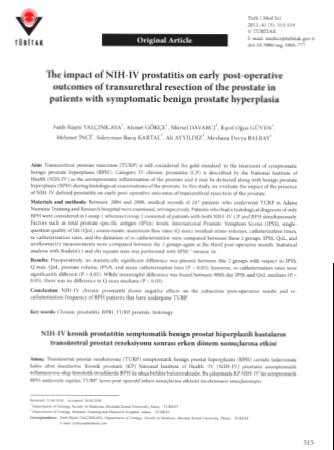
Transurethral prostate resection (TURP) is still considered the gold standard in the treatment of symptomatic benign prostate hyperplasia (BPH). Category IV chronic prostatitis (CP) is described by the National Institute of Health (NIH-IV) as the asymptomatic inflammation of the prostate and it may be detected along with benign prostate hyperplasia (BPH) during histological examinations of the prostate. In this study, we evaluate the impact of the presence of NIH-IV defined prostatitis on early post-operative outcomes of transurethral resection of the prostate. Materials and methods: Between 2004 and 2008, medical records of 247 patients who underwent TURP in Adana Numune Training and Research hospital were examined, retrospectively. Patients who had a histological diagnosis of only BPH were considered in Group 1 whereas Group 2 consisted of patients with both NIH-IV CP and BPH simultaneously. Factors such as total prostate specific antigen (tPSA) levels, International Prostate Symptom Scores (IPSS), single-question quality of life (QoL) assessments, maximum flow rates (Q max), residual urine volumes, catheterization times, re-catheterization rates, and the duration of re-catheterization were compared between these 2 groups. IPSS, QoL, and uroflowmetry measurements were compared between the 2 groups again at the third post-operative month. Statistical analysis with Student’s t and chi-square tests was performed with SPSS ® version 16. Results: Preoperatively, no statistically significant difference was present between the 2 groups with respect to IPSS, Q max, QoL, prostate volume, tPSA, and mean catheterization time (P > 0.05); however, re-catheterization rates were significantly different (P < 0.05). While meaningful difference was found between 90th day IPSS and QoL medians (P < 0.05), there was no difference in Q max medians (P > 0.05). Conclusion: NIH-IV chronic prostatitis shows negative effects on the subjective post-operative results and re-catheterization frequency of BPH patients that have undergone TURP.
DOI
10.3906/sag-1004-777
Keywords
Chronic prostatitis, BPH, TURP, prostate, histology
First Page
515
Last Page
519
Recommended Citation
YALÇINKAYA, FATİH RÜŞTÜ; GÖKÇE, AHMET; DAVARCI, MÜRSEL; GÜVEN, EŞREF OĞUZ; İNCİ, MEHMET; KARTAL, SÜLEYMAN BARIŞ; AYYILDIZ, ALİ; and BALBAY, MEVLANA DERYA (2011) “The impact of NIH-IV prostatitis on early post-operative outcomes of The impact of NIH-IV prostatitis on early post-operative outcomes of transurethral resection of the prostate in patients with symptomatic benign prostate hyperplasia,” Turkish Journal of Medical Sciences: Vol. 41: No. 3, Article 20. https://doi.org/10.3906/sag-1004-777
Available at: https://journals.tubitak.gov.tr/medical/vol41/iss3/20
(Bu içerik Değişik Platformlar taranarak alıntılanmıştır)


